
One Health Publications
Ebola virus disease through the one health lens:… : Journal of Integrative Medicine and Research
October 24, 2026
Conclusion
EVD remains a serious public health threat because of its zoonotic origin, high fatality, outbreak potential and close links with ecological and social factors. Past outbreaks have shown that a biomedical response alone is not sufficient, as spillover and transmission are influenced by wildlife ecology, environmental change, poverty, food insecurity, health-system capacity, burial practices, population movement and community trust.
The One Health approach provides a practical framework to address these interconnected challenges by integrating human, animal and environmental health systems. Strengthening surveillance, laboratory capacity, species-specific vaccination and treatment services, safe burial practices, community engagement and intersectoral coordination is essential for effective Ebola prevention and control. However, current biomedical countermeasures are limited to Zaire ebolavirus, leaving significant preparedness gaps for Sudan and Bundibugyo virus disease, as tragically demonstrated by the 2026 outbreaks. Ebola is therefore not only a virological challenge, but also a reminder that human health is deeply connected with the health of animals, ecosystems, and societies.
View PublicationOne Health through the lens of today’s investment megatrends – BNPP AM Hong Kong – EN
October 24, 2026

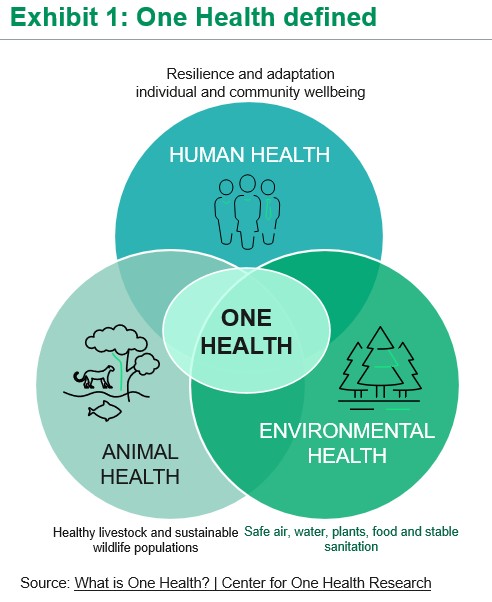
- The One Health concept recognises that human health is inextricably linked to the health of animals and the environment, moving beyond a narrow medical perspective to a systemic view of health-related value and risk
- Assessing One Health through the lens of four megatrends – geopolitics, innovation, demographics, and the environment – helps to identify impacts on worker productivity, supply chain reliability, and market growth
- For long-term investors, health determinants are viewed as material factors that can influence corporate earnings, sovereign credit, and labour markets, helping to identify risks that may currently be underappreciated by the market
The forces shaping human health outcomes are far broader than hospitals, pharmaceuticals and medical devices. Human health is dependent upon animal health and the health of the environment. Together the health of these three systems are inextricably intertwined, creating the One Health concept (Exhibit 1).


One Health (Biology, B.S.) | Old Dominion University
October 17, 2026
About this Program
Old Dominion University offers a Bachelor of Science degree in biology with a major in Biology One Health. The program focuses on the interaction between humans, animals, and the environment. The One Health concept takes a holistic approach to protecting human health using interdisciplinary/multidisciplinary ideas in a collaborative and multisectoral approach.
Program Highlights
- Grant-funded research opportunities in One Health include vector-borne diseases (epidemiology and pathogen biology), fish diseases, schistosomiasis and vaccine development.
- We have expert faculty members that use the rich biological aspects of Hampton Roads, including our diverse ecological communities and biomedical research complex to help students deepen and strengthen their understanding of biology.
- Faculty research experience and expertise are brought directly into the classroom through current and the consistent development of new courses that expose students to a diverse one health perspective to the biological sciences.
New Restrictions on Virus Surveillance: What They Mean for Pandemic Prevention
October 15, 2026
After being terminated in 2025, the network for studying emerging diseases, CREID, has been revived — but with restrictions that could affect scientists’ ability to detect emerging viruses and prevent future pandemics
View PublicationAdvancing One Health implementation and investment: from country action to sustainable solutions – WOAH – World Organisation for Animal Health
October 14, 2026
The Quadripartite organisations (FAO, UNEP, WHO and WOAH) highlight country action, science and investment as priorities for advancing One Health at the 9th World One Health Congress in Lisbon, Portugal.
“The Quadripartite partners – the Food and Agriculture Organization of the United Nations (FAO), the United Nations Environment Programme (UNEP), the World Health Organization (WHO) and the World Organisation for Animal Health (WOAH) – highlighted a shared focus on implementation, science and investment at the 9th World One Health Congress , held in Lisbon, Portugal, from 4 to 7 September, 2026. …”
View PublicationOvercoming the Blind Spot: A One Health Vision to Enhance Human Medicine
October 13, 2026
A One Health Vision to Enhance Human Medicine
Contained in World Medical Journal Nr. 3, September 2026 vol. 72: Pages 24 – 30
SEE: https://www.wma.net/wp-content/uploads/2026/09/WMJ_03_2026.pdf
View PublicationFrontiers | Contribution to foundations from avian biology foundational studies in Japanese quail and domestic chickens demonstrate conserved mechanisms in reproduction throughout the lifespan
October 10, 2026
The concept of One Health encompasses these and other interrelationship of humans, wildlife, and the environment (Figure 1). Utilizing bioindicators …
View PublicationOne Health: The Big Philanthropy Billion-Dollar Blind Spot – Impakter
October 8, 2026
One Health is critical for our collective future — but where’s the money?
Note: IMPAKTER Magazine Leads World Press RE: “One Health concept/approach” – One Health Initiative
View PublicationOneHealthSecure: A One Health Network for the Prevention of Vector-Borne Diseases | Pasteur.fr
October 7, 2026
With the geographical spreading of vectors such as mosquitoes and ticks driven by environmental degradation and climate change, the Mediterranean region is experiencing a constant rise of vector-borne diseases (VBD) outbreaks posing important sanitary and economic challenges.
To address this health concern, the European Commission under the CBRN Centres of Excellence Initiative launched the OneHealthSecure. The aim is to support the countries from the Mediterranean region to adapt to climate change by strengthening their prevention capacities to emerging vector-borne diseases and by adopting a One Health approach.
View PublicationHow political, cultural, and economic forces can shape the risk of zoonotic disease | College of Public Health
October 6, 2026
“ … Because diseases that spread between animals and humans account for most emerging infectious diseases, the researchers emphasize the importance of a “One Health” approach, which considers human, animal, and environmental health together.
“When we think about diseases moving between animals and people, we tend to focus on the pathogen or the animal carrying it. This study shows why we also need to understand the broader and more complex circumstances that affect how people and animals interact,” said Roess, professor of global health and epidemiology in the Department of Global and Community Health at the College of Public Health.
View PublicationThe Evolution of Biosecurity: Moving From Animal Health to One Health
October 5, 2026

Article can also be accessed via:
AND
https://impakter.com/tag/one-health/
View PublicationOne Health modelling in agri-food systems: a scoping review reveals narrow
October 4, 2026
“ … The study, funded by the German Federal Ministry of Research, Technology and Space under the WeAreOne project on public health synergies in the Anthropocene, arrives at a moment when One Health is being institutionalized worldwide, with national plans, dedicated agencies, and international frameworks proliferating. Its central message is a constructive tension: One Health is holistic in principle but narrow in practice, and quantitative modelling is both a symptom of that narrowness and a potential cure. By mapping the methodological state of the art, documenting the institutional shortfall, and proposing a modular framework grounded in genomic, geospatial, and agricultural data infrastructure, Burke and Risius have provided a concrete agenda for turning a unifying philosophy into an operational science. Whether governments seize that agenda will determine whether One Health remains a compelling slogan or becomes the analytical engine that the food systems of the twenty-first century urgently require.”
View PublicationOne Health
October 4, 2026
The recent epidemics and pandemics, in particular COVID-19, have made it unmistakably clear that human, animal, plant, and environmental health cannot be dealt with separately, but need to be addressed in a ‘One Health’ approach. The video delves into the evolution of the One Health concept, tracing its origins back to the XIX century. It demonstrates how One Health contributes significantly to the achievement of the United Nations’ sustainable development goals.
View PublicationQuick Links
-
Please see MONOGRAPH in Veterinaria Italiana
“One Health – One Medicine”: linking human, animal and environmental health
Read More -
History of the One Health Initiative team and website (April 2006 through September 2015) and the One Health Initiative website since October 1, 2008 … revised to June 2020 and again to date February 2021
Read More -
Vaccines for zoonoses: a One Health paradigm
SciTech Europa Quarterly (March 2018) – Issue 26
Read More -
Pan European Networks SciTech Europa Quarterly
SciTech Europa Vaccines for zoonoses: a one Health paradigm – Pages 227-229 (Read PDF) “One of the One Health Initiative team’s co-founders and leaders is an internationally-recognized eminent physician…
Read More Read PDF