
One Health Publications
FACT SHEET: The Biden-Harris Administration Global Health Worker Initiative | The White House [One Health approach utilized]
May 12, 2022
- “…Develop a multidisciplinary Global Health Security workforce. Achieving global health security requires a multi-sectoral approach that incorporates an understanding of the linkages among human, animal, and environmental health– a “One Health” approach. As part of the U.S. Government’s Global Health Security programs, USAID is investing up to $85 million over five years to create a “next generation” health workforce. In 2021, USAID worked with more than 110 universities in 17 countries across Africa and Southeast Asia to train more than 18,000 current and future health workers for more effective disease surveillance and control. CDC has partnered with five leading international organizations to develop the Global Laboratory Leadership Programme (GLLP). The GLLP is a comprehensive One Health-based training program for human and animal health laboratories. The GLLP is currently implemented in over 20 countries in the Americas, Africa, Asia, and the Middle East. In addition, the CDC Field Epidemiology Training Program (FETP) is recognized worldwide as an effective means to strengthen countries’ capacity to prevent, detect, and respond to public health threats through enhanced surveillance, epidemiology, and outbreak response functions. CDC works with partner countries to establish FETPs and to train epidemiologists across all levels of a country’s health system. To date, FETP has been implemented in more than 80 countries around the globe with more than 20,000 graduates with many FETP graduates becoming leaders and managers in Ministries of Health or national public health institutes. These activities accelerate progress of the United States Global Health Security Strategy, and will continue to help our partners build country-level capacities in line with their World Health Organization Joint External Evaluations, National Action Plans for Health Security, and other tools the strengthen compliance with the International Health Regulations (IHR 2005). …”
Nonlethal parasites reduce how much their wild hosts eat, leading to ecosystem effects – The Source – Washington University in St. Louis (wustl.edu)
May 10, 2022
“… “In bringing together experts in a transdisciplinary One Health approach, we bridged health, ecological and theoretical scientists to expand on traditional studies addressing impacts of parasites on individual hosts and host populations to better understand these impacts on the ecosystems where ruminant hosts and their parasites live,” said Sharon Deem, director of the Saint Louis Zoo Institute for Conservation Medicine, a co-author of the new study.
The research effort was conducted by an interdisciplinary and international working group funded by the Living Earth Collaborative, a partnership among Washington University, the Missouri Botanical Garden and the Saint Louis Zoo. The team included biologists, wildlife veterinarians and epidemiologists, ecosystem ecologists, modelers and infectious disease specialists. …”
View Publication
Animals In Space: We Owe Them Now And In Future – Impakter
May 9, 2022
“Since the dawn of the space age in the last century, humans have sent animals into the nether regions to find out if living creatures could survive, to test for various benefits and risks for we humans. It is the way One Health uniquely integrates animals and environmental concerns, in a multidisciplinary context.
We need to recognize that these animals are our explorers, our pathfinders, and heroes even if it isn’t by their choice. …”
View PublicationOne Health Happenings News Notes – April 2022 – One Health Commission
May 9, 2022


One Health Happenings News Notes is prepared and shared monthly by the One Health Commission View archived issues: https://tinyurl.com/OHC-OH-Happening
View PublicationWhat is the economic impact of schistosomiasis? A One Health question. – BugBitten (biomedcentral.com)
May 6, 2022
“ … So what is the true economic impact of schistosomiasis? Only a One Health approach can answer this question.”
View PublicationGlobal Warming Puts Us on the Verge of Virus Spillover
May 6, 2022

New research finds that climate change accelerates the spread of viruses among species causing increasingly frequent disease outbreaks
” … Indeed, the link between humans, animals, plants and the environment is the foundation of what is termed One Health, a concept bringing together experts from all disciplines across the spectrum of human and veterinary medicine as well as ecology and that is increasingly guiding public health policies at the World Health Organization and across the world. ”
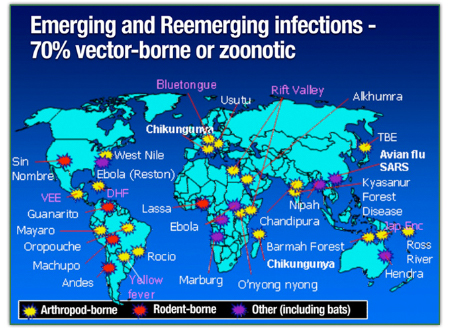
In the Photo: Emerging/Reemerging infections worldwide
Photo Credit: One Health Initiative
New River Health director to speak at Virginia Tech public health commencement (wdbj7.com)
May 5, 2022
The program emphasizes One Health, an approach that reinforces that human health, animal health, and the environment are all connected.
View PublicationRESPIRATORY VIRUS Summit – PANDEMIC PREPAREDNESS: WHERE SCIENCE AND POLICY MEET
May 4, 2022
RESPIRATORY VIRUS Summit – PANDEMIC PREPAREDNESS: WHERE SCIENCE AND POLICY MEET
Fluzine: Respiratory Virus Summit Chairs are proud to present the “Pandemic Preparedness: Where Science and Policy Meet” programme

Avian Flu and the COVID Connection – Impakter
May 2, 2022
Avian Flu and the COVID Connection – Impakter
“… These are early days in Avian flu vaccine development and availability, and in the future we may look to some of the new technologies, such as mRNA, to provide faster and more easily produced vaccines.
But the idea of getting ahead of a possible epidemic or pandemic in poultry is one that could cross over to humans. It certainly warrants attention, given what we have experienced and are experiencing with COVID-19.
And this is only the tip of the iceberg for potential future zoonotic diseases emerging into pandemics equal to or worse than COVID, such as the Nipah virus which has a 40 -75% death rate for humans. Among other interesting developments, Nipah vaccine development programs for a single-dose vaccine are underway.
But the point is this: The next big one could be right around the corner.
We need to pay greater attention and resources to the fact that an estimated 60% of known infectious diseases and up to 75% of new or emerging infectious diseases are zoonotic in origin, i.e. diseases transmitted from animals to humans. And the lesson to be drawn is clear: it is becoming increasingly likely that what works in one species may work in another.”
View PublicationAddressing the Climate Crisis: An Action Plan for Psychologists (apa.org)
May 2, 2022
Addressing the Climate Crisis: An Action Plan for Psychologists (apa.org)
For as much as is known about climate science and One Health impacts of climate change, the problem is fundamentally rooted in human behavior and beliefs. Accordingly, solutions will involve addressing why people think and behave as we do within the contexts of motivation, comprehension, coping, and resilience. A recent report from the American Psychological Association Climate Change Task Force (on which I served) describes challenges and opportunities for us to take substantive measures to preserve human, animal, and environmental health, well-being, justice, and hope for future generations. The report offers a blueprint for multi-sectoral collaboration and curricular modernization for maximal impact. One Health advocates are already leaders in that regard. See the link from *page 10 of this APA document below.
Nancy Chaney, RN, MS, AVES Dipl. (Hon)
One Health Initiative Advisory Board Member
*“… Various multidisciplinary frameworks have emerged in recent years to capture the relationships among the environment, human activity, and human and animal health [e.g., One Health (Deem et al., 2018), EcoHealth, GeoHealth, Planetary Health, the Anthropocene (Zalasiewicz et al., 2019)]. These frameworks can help guide more comprehensive mitigation and adaptation efforts that address the full range of environmental challenges. Although the scope of the task force (and this report) is limited to climate change, the task force encourages APA and others to address climate and other environmental issues in this broader, integrated fashion. …”
*Pg. 10 AMERICAN PSYCHOLOGICAL ASSOCIATION ADDRESSING THE CLIMATE CRISIS: AN ACTION PLAN FOR PSYCHOLOGISTS
Also please see:
One Health Initiative (OHI) Advisory Board member to serve on American Psychological Association (APA) Climate Change Task Force – October 10th, 2020
View PublicationOne Health Commission – 2021 Annual Report
April 29, 2022
|

|
|
|

FAO part of project to boost food safety in Zimbabwe | Food Safety News
April 28, 2022
“ … “For example, experts prioritized the need to train students in a holistic or One Health approach, including skills in communication and behavioral sciences, to be able to address complex issues in food systems such as emerging foodborne diseases and the ability adapt to new technologies and tools, such as bioinformatics, to predict, prevent, detect, control, and respond to foodborne disease threats.” …”
View PublicationEPHA’s response to WHO public hearings regarding a new international instrument on pandemic preparedness and response – EPHA
April 23, 2022
“Measures should be prevention focused, and utilise a One Health approach, as microbial diseases can be spread to humans at all stages of the … ”
View Publication
Quick Links
-
Please see MONOGRAPH in Veterinaria Italiana
“One Health – One Medicine”: linking human, animal and environmental health
Read More -
History of the One Health Initiative team and website (April 2006 through September 2015) and the One Health Initiative website since October 1, 2008 … revised to June 2020 and again to date February 2021
Read More -
Vaccines for zoonoses: a One Health paradigm
SciTech Europa Quarterly (March 2018) – Issue 26
Read More -
Pan European Networks SciTech Europa Quarterly
SciTech Europa Vaccines for zoonoses: a one Health paradigm – Pages 227-229 (Read PDF) “One of the One Health Initiative team’s co-founders and leaders is an internationally-recognized eminent physician…
Read More Read PDF